

I Tried to Divest From Nuclear Weapons. I Couldn't.
Here's how to slice the problem down to size.

Hi Friends,
I conducted a little experiment this week: I tried to divest my personal portfolio of nuclear weapons.
I failed.
And that taught me a few things I hadn’t thought about before.
In my academic life right now I am deep into researching the financing of nuclear weapons and how to regulate it. Because when you look at the problem of how to prevent a nuclear war from a financial perspective, rather than a diplomatic perspective, you see a different picture.
First, you see that this is overwhelmingly a US problem. 14 of the 24 top nuclear weapons producing companies are based in the US.2 These companies not only build US weapons systems but UK weapons systems as well. And 74% of all financing — investments plus loans and underwriting — to these 24 companies comes from US financial institutions.2
Second, you see that the market is the tail wagging the dog. We often talk about nuclear weapons as a policy choice of governments. But when you factor in that these companies donate to the political campaigns of 92 of 100 Senators and 413 of 435 House members, it’s not surprising that the budget for nuclear weapons keeps going up — even though many military and diplomatic experts doubt that these weapons are even a good investment, suggesting that we’d be better off investing in other kinds of weapons or, better yet, in diplomacy. According to ICAN, US nuclear weapons spending rose 22% from 2024 to 2025, reaching $69.2 billion.3
Here’s why this is on my mind. The nuclear weapons problem can seem so big and overwhelming — existential, really. It’s time to slice the problem down to size.
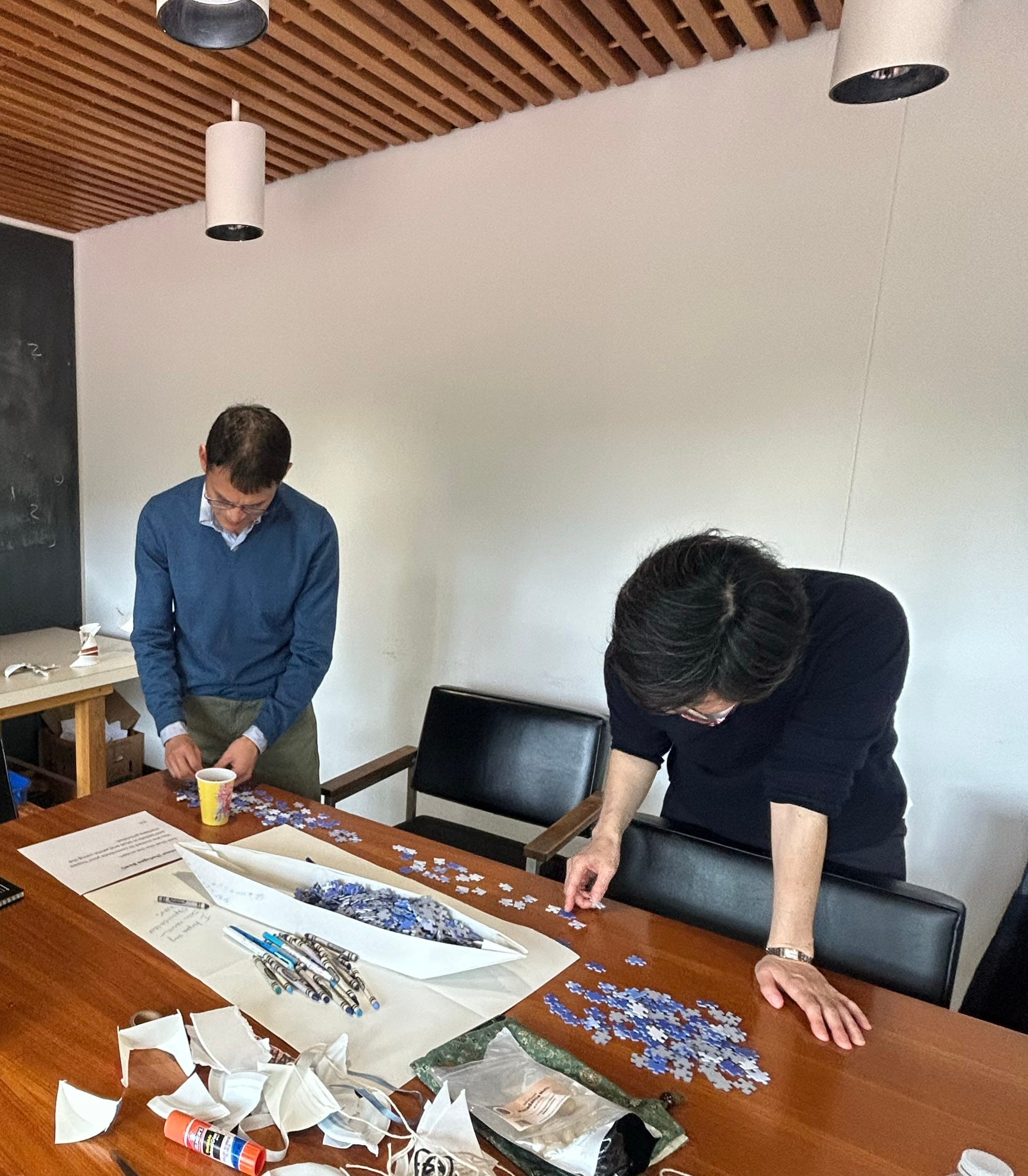
Think about how you do a puzzle. You don’t start with a strategic plan. Maybe you start by just finding the edge pieces, or even more specifically, the edge pieces in a specific color. Then you leave it. Someone comes along and notices a cluster of same-color pieces, and putting these together, discovers that they attach to the straight edge you built. And before anyone decides how to coordinate or what has to be done when, the big unsolvable puzzle has become a set of smaller workable ones.
One way of doing that is to ask, “what’s mine to do?” And my little investment portfolio is one tiny corner of this problem that I own.
This matters because as I argued in my book Financial Citizenship, in a world in which financial institutions are in many ways more powerful than nation-states, citizenship has to be about the power of the purse, not just the power of the ballot box. That’s true in issues from climate to food safety, and it’s true for nuclear weapons too.
My experiment
My guide in this work was a fantastic report created by PAX and ICAN called Don’t Bank on the Bomb.2 It lists all the relevant companies and their investments.
I was shocked to learn that Citibank, where I keep my accounts, have my mortgage, and hold a large part of my retirement funds, is the second largest banking partner of the nuclear industry.2 Moving my low-interest rate mortgage in this high interest rate market is not a realistic option. When it comes to day to day banking, I could find another bank. But what about my retirement funds?
This is where I realized how intertwined the US economy is with the nuclear industry. My employer offers two choices for its retirement program. I learned that the first, Fidelity, is one of the biggest investors in nuclear weapons. But here’s what surprised me: the progressive TIAA-CREF turns out to be highly invested in nuclear weapons as well. I reached out to my TIAA investment advisor — what about the socially responsible investment products TIAA offers? It turns out those have no restrictions on weapons manufacturers either.
I am not finished with this experiment — there are some financial advisors out there who specialize in helping you navigate this terrain. I’ll report back.
But the bottom line is this: if you’re a regular individual investor in the US, you don’t have much of a choice. The nuclear weapons industry is so deeply intertwined with our financial markets that you’re part of it.
How is that “freedom”?

This little experiment — focusing on just my own portfolio, one corner of an overwhelming problem — is a simple example of a much bigger peace-building move. International lawyers have a name for it: dépecage, or “slicing.” They take conflicts that look total and unsolvable and break them into pieces that can actually be resolved — piece by piece, not all at once.
Diplomats do this all the time too. They slice the issues into different pieces, and agree to deal with some issues now, and shelve others for negotiation later. It’s not giving it, it’s not a compromise, it’s strategic sequencing.
This month’s Field Guide gives you the full slicing framework: where it comes from, how to use it on the real-life conflicts you’re navigating right now, and a worked example involving a fight over a mosque in my town in Japan (which I talk a bit about in the video). Plus eight reflection questions and a downloadable guide for applying dépecage to whatever conflict you’re sitting with.
